The FIFA World Cup: A Different Perspective
How Football’s Emotion Became a Global Industry
By S.K. Das and Ahmed Borhan
ABSTRACT
The FIFA World Cup is usually understood as a sporting spectacle — a celebration of skill, national pride, and collective joy. This essay looks past that surface to examine the vast economic architecture built underneath it, one in which human emotion itself has become a marketable commodity. Drawing on Karl Marx’s idea of commodity fetishism and Antonio Gramsci’s theory of cultural hegemony, the essay traces how football spectatorship has grown from a spontaneous, communal activity into a multi-billion-dollar global industry powered by broadcasting rights, sponsorship, merchandising, and data. It looks at how football stars are turned into marketable brands, and how fans — while genuinely feeling joy — simultaneously become a product sold to advertisers. It then widens the lens to the tournament’s own physical and financial growth: the expansion from 32 to 48 teams, the shift from a single host nation to a tri-national hosting model for 2026 (the United States, Canada, and Mexico), and the resulting surge in FIFA’s revenue and global reach. Finally, it examines a small but telling case study of this same pattern: the mandatory in-match hydration breaks introduced at the 2026 tournament, framed as a player-welfare measure but functioning, in practice, as one of the most lucrative new advertising slots in sports broadcasting history. The question this essay asks is not whether commerce should exist alongside sport, but whether commerce now serves the game — or whether the game has quietly become commerce’s servant.
INTRODUCTION
Every four years, the FIFA World Cup draws a share of humanity larger than almost any other single event on Earth. Flags go up, jerseys come out, streets empty, and for ninety minutes at a time, hundreds of millions of strangers feel, briefly, like members of the same family. That feeling is completely real. It is one of the purest expressions of collective joy that modern life still has to offer.
But running alongside that shared emotion is a quieter, less visible story — one of broadcasting contracts, sponsorship auctions, ticket-pricing algorithms, and decisions made in boardrooms thousands of miles from any stadium. This essay tries to hold both stories in view at once: the World Cup as a human celebration, and the World Cup as one of the largest commercial enterprises on the planet.
The discussion unfolds in three parts. The first asks how the game itself — the goals, the crowds, the emotion in the stands — became something that could be bought and sold, tracing the economics of attention, broadcasting, and advertising that now sit underneath the tournament. The second turns to the individual player, examining how footballers are transformed from athletes into global brands, using Marx’s idea of commodity fetishism and Gramsci’s theory of cultural hegemony as tools for understanding that shift. The third widens the lens further, to the tournament’s own physical and financial scale: its growth from 32 to 48 teams, from one host nation to three, and even the monetisation of an in-match pause meant, on paper, to protect players’ health.
None of what follows is an argument against football, or against the players and fans who give the game its meaning. It is, instead, an invitation to look more closely at the economic machinery that now surrounds the sport — and to ask, honestly, whether that machinery still serves the game, or whether the game has quietly come to serve it
.
The Philosophy of Sport: Play, Virtue, and Meaning
Before turning to the economics of the World Cup, it is worth asking a more basic question: what is sport actually for? The answer matters, because everything that follows in this essay is really a story about tension between what sport has always meant to human beings, and what the market has learned to do with that meaning. Long before any match was broadcast, people ran, wrestled, and competed simply because the body and spirit demanded it — play preceded profit by thousands of years, arising independently in nearly every human culture. Understanding what sport meant before it became an industry is the only way to see clearly, later in this essay, what has been gained and what has been quietly lost in that transformation.
Play as an End in Itself
The Dutch historian Johan Huizinga argued, in his influential study Homo Ludens, that play is not a by-product of culture but one of its foundations — older than law, older than religion. It creates its own temporary world, a kind of magic circle with its own rules and its own seriousness, entered into freely and for no reason beyond itself. The philosopher Bernard Suits pushed the idea further, defining a game as the voluntary attempt to overcome unnecessary obstacles: there is no practical reason to kick a ball into a net rather than simply carrying it there by hand, but that self-imposed difficulty, accepted willingly, is precisely what turns the activity into a game rather than a chore. Sport, on this view, is one of the few human activities whose entire value lies in the doing of it, not in what it produces.
The Virtues of Competition
This intrinsic quality of play does not mean sport is empty of purpose — only that its purpose lies inside the activity rather than outside it. Aristotle’s idea of arete, or excellence, saw physical contest as one route to eudaimonia, human flourishing, because it demanded real virtues: courage under pressure, discipline built over years, fairness even when victory is at stake, and grace in both winning and losing. The Greek concept of agon treated competition not as conflict to be avoided but as an honourable way for human excellence to test and reveal itself. These are the same virtues fans still recognise in the World Cup — a player working for the team rather than personal glory, a captain accepting a hard refereeing decision, an underdog competing with dignity against long odds. None of it requires a market to exist. It requires only two teams, a set of rules, and the shared will to take the contest seriously.
Sport as Shared Meaning
Sport also carries a social and even spiritual dimension that predates its commercial one. Anthropologists have long noted that organised contests function, in many societies, as a form of ritual — a structured way of expressing collective identity, working through tension, and marking time. The World Cup’s flags, chants, and shared colours are modern versions of something very old: a community defining itself, briefly and joyfully, against another. The catharsis of a last-minute goal, the shared grief of a loss, the sense of belonging that a stadium or a living room full of strangers can produce — these are not manufactured effects. They are, philosophically speaking, close to what Aristotle meant by catharsis in tragedy: an emotional experience valuable simply for being felt, together, in the moment. None of this is a naive claim that sport has ever existed in some pure state, untouched by money or power — professional sport has always involved patrons, prizes, and audiences. But there is a meaningful difference between commerce existing alongside a game whose core value is intrinsic, and commerce reshaping the game itself around what is most profitable to broadcast. It is against this philosophical backdrop — play as freedom, competition as virtue, and sport as shared meaning — that the economic transformation examined in the rest of this essay becomes visible not merely as an interesting business story, but as a genuine tension at the heart of the modern game.
- When the Game Becomes a Commodity
The Attention Economy
Play has always been part of human life. Children kicking a ball around in a field, boat races along a riverbank, wrestling matches in a village square — these are spontaneous expressions of joy, competition, and the simple desire to be together, and none of them come with a price tag. People play, and always have, because play itself carries a taste of freedom.
That instinct hasn’t disappeared. What has changed is the machinery built around it. When a World Cup match begins, hundreds of millions of people across nearly every continent sit down in front of a screen. A single goal can send millions into euphoria; a single defeat can bring them to tears. That emotion is genuine — created by people themselves, for themselves.
But it raises an uncomfortable question: who actually benefits most from this wave of feeling? The person watching the match — or the corporations that have learned to convert human emotion into revenue? This isn’t only a question about football. It touches something much larger about modern life, in which almost every human feeling — love, friendship, faith, art, and now sport — has become, in one way or another, a potential market.
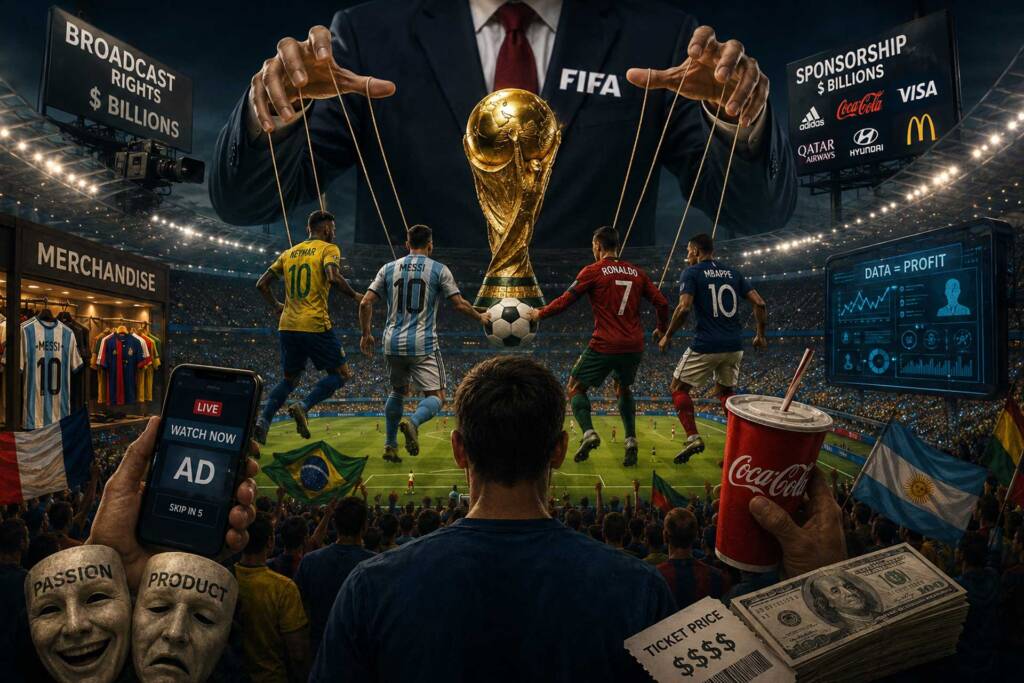
Economists call the resource being harvested here the attention economy. A fan sits down purely to enjoy the game. In that same moment, a stream of unrelated products — cars, soft drinks, phone plans, betting apps, loans, insurance, cosmetics — is scheduled to pass directly in front of their eyes. The spectator is not only watching football; they are, at the same time, becoming a product themselves, one whose attention is being sold to advertisers. That single fact is the foundation on which the rest of modern sports economics is built.
It is also why the World Cup today is no longer simply a football competition. It functions simultaneously as a global television programme, a vast advertising marketplace, a marketing festival for multinational corporations, an engine for the tourism industry, a retail event for shirts, boots, flags, and video games, one of the biggest assets in the streaming business, and increasingly the centrepiece of the international sports-betting market. Attached to the joy of a single goal is an economic machine worth tens of billions of dollars. The football pitch is no longer simply a patch of grass — it is a stage for global capital.
The Economics of Emotion
Capitalism’s particular skill is bringing not just human needs but human feelings into the marketplace. When a supporter buys a jersey, they are not simply buying a piece of clothing — they are buying a sense of identity, a feeling of belonging to something larger than themselves. They buy tickets, take out streaming subscriptions, purchase special-edition boots, and follow their club religiously on social media. At every one of these steps, emotion is quietly converted into economic value.
This is where Karl Marx’s idea of commodity fetishism becomes useful. Marx observed that under capitalism, we tend to treat the value of an object as though it were natural and self-evident, when in fact that value comes from something invisible — human labour, social relationships, and the story built up around the object. A World Cup jersey works the same way. A supporter believes they are buying a piece of their favourite club. In economic terms, what they are actually doing is increasing the market value of a brand. Corporate marketing has become remarkably skilled at using this emotional bond for its own purposes.
Citizen or Consumer?
This raises a genuine question: are we still spectators of the game, or have we become, in effect, consumers of it? Before a match even kicks off, sponsors’ logos are already on screen. Advertising boards line the pitch. Advertisements sit on the players’ jerseys. Press conferences are held in front of branded backdrops. Broadcasts pause for commercial breaks. At times, it can feel as though the football is being played in the gaps between the advertisements, rather than the other way around.
None of this diminishes the fan’s joy, which remains real. But the enormous economic structure built around that joy is not designed, first and foremost, to protect the beauty of the game — its central purpose is to maximise profit. Understanding modern sports economics, then, requires looking past goals, passes, and tactics, toward advertising contracts, broadcasting rights, brand value, corporate ownership, and the movement of global capital.
FIFA — The Business Behind the Beautiful Game
FIFA is usually described as the regulatory body of international football. Economically, though, it functions as one of the most powerful commercial institutions on Earth. That helps explain why nations compete so fiercely to host the World Cup. Hosting is never really just about football — it is tied to international tourism, airport expansion, hotel construction, public transport upgrades, security infrastructure, and real estate development. Countries often spend decades accumulating public funds for the chance to host a single tournament.
An important question follows: who actually benefits from that spending? Is it the local population, or is it the international construction firms, advertising agencies, and broadcasting companies who move on once the tournament ends? The honest answer is that it varies — but a familiar pattern recurs. In the years after a World Cup, many stadiums built at enormous cost see little further use, even as the multinational corporations involved in staging the tournament walk away with substantial profits.
The Football Match as a Commodity
In economic terms, something becomes a commodity once it can be bought and sold in a market. A football match itself cannot really be sold — but the right to watch it can, and that right is the single greatest invention of modern sports economics.
Take a World Cup final. Roughly eighty thousand people sit inside the stadium. Through television, mobile phones, and streaming platforms combined, that same match is watched by several billion more. In effect, one game is sold over and over again — this is what broadcasting rights actually means. A television network pays billions of dollars for the right to air the tournament, then earns that money back, and more, by selling advertising around it. Streaming platforms add another income stream through subscriptions. Layered on top of all this are further revenue streams: social media clips, re-broadcasts, and the data generated by every viewer. A single football match, in other words, has become a complex financial product built from information, technology, and economics — of which the actual football on the pitch is only one part.
Advertising, in fact, shapes the broadcast itself. Where the camera lingers, how long a particular shot stays on screen, which brand’s logo appears beside the pitch — all of it reflects a marketing strategy running quietly underneath the match. A player, seen through this lens, is never simply an athlete; they are also a moving advertisement, and a famous footballer’s personal following on social media can end up mattering more, commercially, than their performance on the pitch.
There is a well-known idea in media economics: if a service is free, the user is probably the product. This applies neatly to sports broadcasting. Television networks and streaming platforms are not really selling football to the spectator — they are selling the spectator’s attention to advertisers. The game is the lure, the spectator is the resource, and advertising is how that resource is converted into profit. In the digital age, this extends beyond attention to data itself: every click, comment, “like,” and search adds economic value, meaning both a fan’s emotion and their digital footprint have become commodities in their own right.
A Fundamental Question
Is all of this simply harmful? The honest answer is no — not entirely. This same commercial machine has funded advanced training methods, modern stadiums, progress in sports science, and professional careers for athletes who would once have had none.
But it has also produced real costs. Wealthy clubs have grown wealthier. Talented young players from poorer nations are drawn into a global market before they are old enough to fully understand its terms. And in many cases, the cultural spirit of the game has been quietly overshadowed by the logic of profit. The real question, then, was never whether commerce belongs in football — it always has, in some form. The question is whether commerce still serves the game, or whether the game has become commerce’s servant. That question carries into the next part of this discussion.
- Hero, Brand, and the Worship of the Commodity
When a World Cup match ends, the conversation usually centres on who scored, who defended well, who delivered a brilliant pass, and who fell short. But a second, quieter contest runs throughout the tournament: the making of heroes. In modern football, a player’s greatness is never built by talent alone — cameras, advertising, media coverage, social platforms, and corporate marketing all take part in constructing it. At times, a footballer’s market value grows to exceed even their footballing greatness. The question worth asking is why.
From Player to Brand
A talented footballer earns success through hard work, discipline, and skill built over years. The advertising industry then translates that success into the language of the market. A player’s face sells shoes. Their smile sells soft drinks. Their sprint sells sportswear, and their lifestyle sells watches, perfume, and cars. Somewhere in that process, the player stops being simply a human being and becomes what marketers call a marketable identity — a case in which the line between the individual and the commodity grows genuinely blurred.
The Worship of the Commodity — Marx’s Insight
In Das Kapital, Karl Marx introduced the idea of commodity fetishism — the observation that under capitalism, a commodity’s value can come to feel inherent and almost mysterious, when in reality that value is built from human labour, social relationships, and a hidden history of production. Modern sports commerce gives this idea a new form.
Consider a famous footballer’s jersey. In terms of fabric and stitching, it is barely different from an ordinary shirt. But add a famous name and number to the back, and its price multiplies many times over. The buyer isn’t really purchasing cloth — they are purchasing a symbol, a dream, an emotional connection. In economic language, the commodity has gained far more exchange value than use value, and that surplus is created entirely through imagination, media coverage, and brand-building.
Gramsci’s Cultural Hegemony
The Italian thinker Antonio Gramsci offered a related but distinct insight: that a ruling class maintains its dominance not only through economic power, but through culture, education, media, and the quiet consent of ordinary people. He called this cultural hegemony, and it applies just as well to sport as it does to politics.
Audiences are told, repeatedly and from every direction, that big clubs are naturally big, that big brands are inherently superior, that expensive jerseys are more authentic, and that famous players represent the ideal of a successful life. None of these ideas are self-evident truths. They are the product of long-term cultural construction — built and reinforced over decades of marketing until they simply feel like common sense.
Children, from an early age, want to be like their favourite player. That desire is entirely natural. But when marketing quietly reshapes that desire into brand loyalty, football culture gradually becomes absorbed into consumer culture, and the two become difficult to tell apart.
The Light and Shadow of Media
Media coverage undeniably makes players known across the world — that much is true. But the media’s spotlight is never distributed evenly. A star player’s every training session becomes news, while the years of unseen labour by thousands of lesser-known players go largely unreported. The camera has its own economics: it follows wherever the audience’s attention already lies, and advertising money follows wherever the camera goes. As a result, the media doesn’t simply report on what matters — in practice, it often decides what matters in the first place.
Heroes, Aspiration, and Its Limits
A football star can genuinely inspire hundreds of millions of people, and there is real value in that — for young people especially, an example of discipline, perseverance, and creativity is worth a great deal. The trouble begins when success itself becomes fused entirely with fame, wealth, and consumption. The player’s human effort fades into the background, replaced in the public imagination by their new car, their new house, their follower count, and the size of their endorsement deals. Fans gradually come to follow not the game itself, but the consumer fantasy constructed around it.
It’s worth stressing that none of this is a criticism of individual players, who have earned genuine respect through talent and sacrifice, and whose success is real and deserved. The relevant question is not about them — it’s about who actually benefits from the vast commercial structure built on top of one person’s talent: the player, the spectator, or the corporate system that has learned to convert every emotion into a transaction.
There is, in fact, something almost religious about how supporters experience the World Cup — the flags, the shared colours, the rituals, the sense of belonging to a collective identity for a few weeks every four years. This is a natural and very human cultural instinct. The risk lies in what happens when that instinct is harnessed to expand a commodity market: sport risks becoming what might be called a market-mediated civic ritual, one in which the object of devotion quietly shifts from the game itself to the brand and the sponsor standing beside it.
III. More Teams, More Hosts, More Money
If the expansion from 32 to 48 teams and from one host nation to three represents football’s commercialisation on a macro scale, the tournament’s new hydration break shows the same logic in miniature — a single three-minute pause revealing, with unusual clarity, how a “player welfare” measure can quietly become one of the most profitable advertising inventions in the sport’s history.
From 32 Teams and One Host, to 48 Teams and Three
For decades, the World Cup meant 32 nations, 64 matches, and a single host country. Beginning in 2026, jointly hosted by the United States, Canada, and Mexico, it expands to 48 teams, 104 matches, and sixteen host cities spread across three nations — the largest expansion in the tournament’s history, which FIFA’s own leadership has compared to hosting “104 Super Bowls.” FIFA presents this as football’s democratisation, widening access for nations across Africa, Asia, and the CONCACAF region. It is, just as clearly, a commercial strategy: more matches mean more broadcast windows, more sponsorship placements, and more ticket sales, while three national markets — three broadcasters, three sponsorship ecosystems, three tourism economies — now feed a single revenue stream that FIFA controls directly, even as host cities and governments absorb the costs of security, transport, and infrastructure.
The Financial Scale of Expansion
The numbers make the shift concrete. FIFA’s 2023–2026 commercial-cycle revenue, once projected at $11 billion, has been revised upward to a record $13 billion, with roughly $8.9 billion coming directly from the 2026 World Cup — up from $7.5 billion in Qatar in 2022 and $5.6 billion in Russia in 2018. That is a rise of about 70 percent in a single four-year cycle, and more than fourfold over two decades. Broadcasting rights remain the largest single stream, nearing $4 billion, with U.S. domestic rights alone up almost 94 percent, followed by sponsorship at $2.4–2.8 billion, boosted by newer partners such as Saudi Aramco alongside long-standing sponsors like Coca-Cola and Visa. For the first time, dynamic ticket pricing has pushed final-match seats into the thousands of dollars, making 2026 the most expensive World Cup ever staged — even as FIFA expects a record 5.5 million in-person attendees and record prize money of $871 million.
Uneven Gains — Down to the Water Break
These gains are not shared evenly, and the same pattern now reaches into the match itself. Independent economists caution that host-city growth projections often overstate the real local benefit once displacement effects are properly accounted for, and several U.S. host cities are already reporting budget shortfalls even as FIFA’s central revenues climb.
That same dynamic shows up, almost perfectly, in the tournament’s new mandatory hydration breaks — introduced as a player-welfare measure against North American summer heat, applied even in air-conditioned stadiums where the heat risk barely exists, and quickly repurposed as a broadcast product. Two scheduled three-minute pauses per match, across 104 matches, have created more than 800 new sellable advertising slots, worth an estimated $250 million — potentially as much as $600 million — to Fox Sports alone in the United States, and over $1 billion globally, at rates as high as $750,000 for a single 30-second spot during USMNT matches. Non-commercial broadcasters like the BBC have chosen to leave the pauses ad-free, a useful reminder that the windfall is a choice the break makes possible, not something inherent to player welfare itself.
Taken together, the tournament’s growth from 32 teams to 48, from one host to three, and the monetisation of even a three-minute pause for water all point toward the same conclusion: an event whose emotional core belongs to hundreds of millions of ordinary supporters, but whose financial architecture — down to the rhythm of play itself — is built to maximise returns for a comparatively small number of institutional and corporate stakeholders.
Conclusion
The beauty of the game lies in human creativity. The goal of the market lies in profit. On the surface, these two things are not inherently in conflict — but they are not the same thing either, and treating them as identical is exactly how one quietly comes to serve the other.
Return, for a moment, to Huizinga’s magic circle — that voluntary, self-contained space where play matters only because the players agree it should. The World Cup still contains that circle; it is there every time a child mimics a star’s goal celebration in an alley, every time a fan cries at a result that changes nothing material about their life. What has changed is everything built around the circle: the broadcasting deals, the sponsorship slots, the pause for water repackaged as a commercial. The philosophical value of sport — play for its own sake, virtue tested through fair contest, meaning made and shared collectively — has not disappeared. It has simply been surrounded, almost entirely, by a machine designed to extract profit from it.To love football, and to critically examine the commercial structure built around it, are not opposing positions. If anything, the second is what makes it possible to protect the first. That task grows only more urgent with each new edition of the tournament, as the World Cup becomes larger, richer, and more thoroughly commercial than the one before it — right down to the length, and now the profitability, of its pauses.