Paper Tiger Paradox: Propaganda and Symbolic Violence
Dr. S K Das and Ahmed Borhan
Centre for Social Research (CSR), Bangladesh
Abstract
Modern warfare is waged not only on physical battlefields but within the human psyche. Today, a powerful alliance of governments, media corporations, intelligence agencies, and think tanks generates a relentless stream of narratives designed to manufacture fear, fabricate enemies, and frame ballooning military budgets as simple “common sense.” This paper argues that these narratives are not merely political spin — they are a form of the invisible exercise of power through meanings that people accept as natural truth rather than as deliberate manipulation. The paper examines how state machinery, media systems, and international organizations work together to escalate tension, deepen mutual distrust, and lock nations into permanent rivalry. A central concern of the paper is the devastating cost this propaganda-driven militarization imposes on the Global South: nations such as India, Pakistan, Ethiopia, and those of the Sahel region spend rising shares of public money on weapons while millions of their children go hungry and millions of their citizens remain trapped in poverty. The paper documents how global media — concentrated in a handful of Western corporations — acts as the delivery system for these narratives, shaping how billions of people understand security, threat, and legitimate violence. It concludes that exposing propaganda is not a luxury for academics: it is a necessary first step toward freeing public resources for human development and toward building the mutual understanding that genuine peace requires.
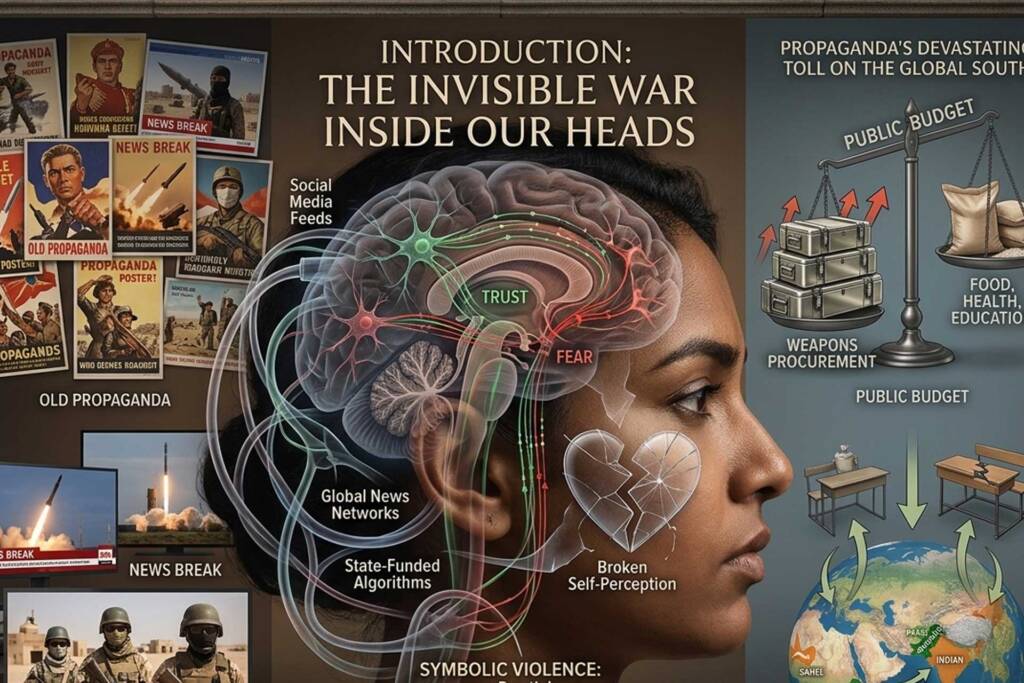
Introduction: The Invisible War inside Our Heads
When we think of war, we picture missiles, soldiers, and destroyed cities. But there is another kind of war — quieter, older, and in many ways more powerful — that is fought every day through television screens, social media feeds, newspaper headlines, and official government statements. This is the war of propaganda: the deliberate shaping of how people understand the world, who they fear, who they trust, and what sacrifices they are willing to make.
Propaganda is not a new invention. Governments have always tried to control the story. But in the twenty-first century, it has become more sophisticated, faster-moving, and harder to detect than at any point in history. It is no longer just posters or state radio broadcasts. It is embedded in the algorithms of social media platforms, in the sourcing structures of global news networks, in the funding of prestigious think tanks, and in the carefully designed press briefings of defence ministries.
What makes propaganda especially powerful today is precisely that most people do not recognise it as propaganda. They experience it as news, as analysis, as common sense. The French sociologist Pierre Bourdieu gave this phenomenon a precise name: symbolic violence. He defined it as the imposition of power through meanings — through categories, narratives, and beliefs that the dominated accept as natural rather than recognising them as instruments of control (Bourdieu, 1991). Unlike physical violence, symbolic violence leaves no visible bruises. It works from the inside.
This paper traces how symbolic violence operates through propaganda in the modern world. It examines how propaganda has manufactured and maintained each of these rivalries. It then turns to the devastating economic consequences: particularly for nations of the Global South, where propaganda-driven fear of enemies diverts public money from food, health, and education into weapons procurement. Finally, it analyses the role of global media as the infrastructure through which symbolic violence travels from state power to individual consciousness.
How Symbolic Violence Works in Geopolitical Propaganda
When applied to the international arena, Pierre Bourdieu’s framework of symbolic violence illuminates what purely military or economic analyses often miss: why populations support conflicts that actively damage their own interests. It explains why citizens in developing nations accept bloated defense budgets that divert funds from essential food security and education for the most marginalized, and why people internalize “enemy images” of distant nations as though they were their own reasoned conclusions.
The answer lies in the state’s capture of the habitus—the deeply ingrained habits, skills, and dispositions we carry. From childhood, citizens are immersed in media, textbooks, and political rhetoric that frame the world in binary terms: certain countries are designated as permanent friends, while others are cast as existential rivals. Military actions are selectively labeled as either “defensive” or “aggressive” depending on the actor. Repeated across countless sources over decades, these framings become the cognitive equipment of national identity. They cease to be beliefs to be examined and instead become the invisible background assumptions through which all new information is filtered.
Consequently, propaganda does not need to lie to be effective; it simply needs to select, frame, emphasize, and repeat. A genuine attack by an adversary is presented as uniquely shocking, while a comparable attack by one’s own state is contextualized as a defensive necessity. A stark poverty statistic can be ignored, while a minor military threat is amplified into an emergency. In this system, the act of selection itself is the violence—yet it remains invisible because it masquerades as objective journalism.
How Propaganda Manufactures and Maintains Rivalry
The global “industry of enmity” functions as a system of symbolic violence, where states across diverse geopolitical theaters—from the “chosen trauma” of the Korean Peninsula and the hyper-nationalist rhetoric of India and Pakistan to the strategic sectarianism of the Middle East—weaponize the spectre of an existential “Other” to justify internal control and systemic militarisation. By embedding these manufactured rivalries into the national habitus through linguistic asymmetries in Western media, state-controlled information operations in Russia and China, and the profit-driven narratives of the military-industrial complex, regimes transform the deprivation of their own citizens into a perceived act of national sacrifice. This permanent state of crisis ensures that bloated defense budgets and nuclear proliferation are prioritized over chronic food insecurity and social infrastructure, effectively consuming the resources required for human survival to sustain the machinery of state dominance. Western propaganda operates through structural dominance rather than state broadcasting, utilizing global wire services (Reuters, AP, and CNN) and coordinated NATO messaging to set the international agenda.
In the Indian subcontinent, governments utilize “manufactured enmity” and hyper-nationalist media to justify massive military spending, such as India’s $83.6 billion defense budget. This propaganda ensures that “national security” remains the priority, even as 230 million Indians remain undernourished and 40% of Pakistani children suffer from chronic stunting due to malnutrition. By casting the neighboring country as an existential threat, both states successfully redirect vital resources away from food infrastructure and into a nuclear arms race, effectively “consuming the resources that could feed hungry children.”
The rivalry between Iran and Saudi Arabia is one of the most dangerous in the world — and one of the most deliberately constructed through propaganda. It is frequently described as a sectarian conflict between Shia Islam (represented by Iran) and Sunni Islam (represented by Saudi Arabia). This religious framing obscures the underlying strategic competition for regional dominance, in which both sides have weaponized faith as a tool for political mobilization. The heaviest cost of this manufactured rivalry falls on Yemen, where a Saudi-led intervention against Iran-aligned Houthi forces has triggered a catastrophic humanitarian crisis. By late 2022, 21.6 million people—two-thirds of the population—required aid (OCHA, 2023). The propaganda machines of both regimes, alongside their external backers, mask this suffering by framing the catastrophe as an unavoidable consequence of the other side’s aggression.
How State Machinery Produces and Sustains Propaganda
Institutional framework
Modern propaganda is not the product of a single source but an interlocking network of institutional actors with aligned interests. This ecosystem creates a pervasive and resilient narrative structure through four primary channels:
First, defense and interior ministries control the flow of security information, creating a “sourcing dependency” for journalists. This structural reliance on official briefings and military embeds ensures that media coverage is systematically filtered to favor state narratives (Entman, 2004). Second, intelligence agencies—historically exemplified by the CIA’s Cold War influence operations and currently by modern cyber units—covertly shape public opinion both domestically and abroad (Saunders, 1999).
Third, think tanks provide a veneer of independent expertise while often operating as conduits for the defense industry. Research reveals that major U.S. policy centers received over $1 billion from defense contractors in a single decade, fundamentally compromising their strategic neutrality (Thrall et al., 2020). Finally, educational systems perform the most profound function by embedding national rivalries into the habitus of entire generations. Through biased textbooks and selective historical commemoration, the “enemy” is transformed from a political construct into a self-evident, psychological truth (Bar-Tal, 2007). This infrastructure ensures that propaganda remains invisible by masquerading as professional journalism, expert analysis, and objective history.
The Digital Turn: Social Media as Propaganda Infrastructure
Social media platforms have fundamentally transformed the propaganda landscape, accelerating the production and circulation of conflictual narratives while creating the appearance of spontaneous citizen expression. The Oxford Internet Institute’s Computational Propaganda Project, tracking organised social media manipulation across 81 countries as of 2021, found evidence of government-sponsored disinformation operations in all major regions of the world (Bradshaw & Howard, 2020).
Algorithmic design has compounded the propaganda potential of social media. Platforms optimised for engagement metrics — likes, shares, comments — systematically favour emotionally arousing, identity-affirming, and outrage-generating content. Conflict narratives, enemy images, and existential threat framings are precisely the types of content that generate the most engagement, meaning that platform design itself amplifies propagandistic content without any direct intervention by state actors (Wardle & Derakhshan, 2017).
The 2020 Stanford Internet Observatory investigation documented an extensive network of fake news sites and coordinated social media accounts, linked to actors in India and Pakistan, producing and distributing hostile content about each other across multiple platforms in English, Urdu, Hindi, and other languages. The operation involved hundreds of fake websites, thousands of fake social media accounts, and content reaching millions of users — all presenting manufactured or misrepresented information as authentic journalism (Stanford Internet Observatory, 2020).
Global Media: How Opinions Are Manufactured and Believed
To understand how propaganda reaches billions of people and is absorbed as truth rather than experienced as manipulation, it is necessary to understand the structural organisation of global media. Six major corporations — Comcast/NBCUniversal, The Walt Disney Company, Warner Bros. Discovery, News Corp/Fox Corporation, Paramount Global, and Sony — account for the overwhelming majority of English-language media content consumed globally. Their news divisions, digital platforms, and entertainment properties together reach the majority of the world’s media consumers.
More importantly for understanding global news framing, two wire services — Reuters and the Associated Press — supply the raw material from which the majority of international news stories are assembled by local media organisations around the world. A newspaper in Lagos, a television station in Dhaka, a radio broadcaster in Lima — all rely on these two organisations for breaking international news. Both are headquartered in Western capitals, both have deep historical relationships with Western governments and financial institutions, and both operate within the professional conventions of a journalism culture shaped by Anglo-American assumptions about what constitutes legitimate political speech (Boyd-Barrett, 2015).
This is not a conspiracy: it is a structural feature of media capitalism that Bourdieu’s concept of field helps explain. Journalists at major international outlets operate within a professional field that defines credibility through adherence to official sources, institutional access, and the dominant political consensus of their operating environment. Those who consistently challenge official narratives lose access, face accusations of bias, and encounter what Herman and Chomsky (1988) called flak — organised criticism from powerful institutions designed to discipline journalistic behaviour.
How the Manufacturing of Consent Works in Practice
In Manufacturing Consent (1988), Edward Herman and Noam Chomsky provided the definitive analysis of how media systems create narratives that serve the powerful without the need for direct government censorship. Their “propaganda model” identifies five filters that information must pass through before it reaches the public: ownership, advertising revenue, sourcing dependencies, flak (backlash), and dominant ideologies. Forty years later, these filters remain highly effective, though their forms have evolved. Media ownership has consolidated into even fewer hands, and while the digital age has introduced more voices, official government sources still dominate the most influential channels. The “flak” mechanism has been supercharged by social media “pile-ons,” and the core ideology has shifted from Cold War anti-communism to a focus on anti-terrorism, “democratic norms,” and a growing anti-China consensus. The practical result is a global news environment that favors Western perspectives while silencing the Global South. This creates a striking double standard: when Western powers launch military operations, the media often frames them as “necessary and precise.” However, when non-Western nations do the same, their actions are primarily described as “brutal,” “illegal,” or “existential threats.”
Why People Believe: The Psychology of Propaganda Reception
It is not enough to document how propaganda is produced and distributed. We also need to understand why it works — why intelligent, educated people accept narrative framings that, under sustained critical scrutiny, collapse.
The most important mechanism is what cognitive psychologists call the illusory truth effect: repeated exposure to a claim increases its perceived truthfulness regardless of its actual accuracy (Hasher, Goldstein & Toppino, 1977; Pennycook et al., 2018). Media repetition of threat narratives — the same enemy image circulated across television, print, social media, and official statements — literally changes the probability assessments of people who consume it. The claim feels true because it feels familiar.
Bourdieu’s concept of habitus explains the deeper cultural layer of this psychological effect. When propaganda aligns with existing cultural narratives — existing enemy images, historical grievances, religious or ethnic identities — it does not feel like new information. It feels like confirmation of what was already known. The citizen who has grown up in a society whose media consistently portrays a particular nation as treacherous, aggressive, or inferior does not experience new stories confirming this view as propaganda; they experience them as news.
Social identity theory, developed by Henri Tajfel and John Turner (1979), provides a third layer of explanation. When people understand themselves primarily as members of national or ethnic groups, information that threatens the group activates identity-protective cognition: a systematic bias toward information confirming in-group virtue and out-group menace, and away from information that complicates this picture. Propaganda that successfully activates national identity makes critical evaluation of security narratives psychologically costly — it feels like disloyalty.
The combination of these three mechanisms — illusory truth, habitus formation, and identity-protective cognition — explains why propaganda does not need to be particularly sophisticated to be effective. It simply needs to be consistent, repeated, emotionally resonant, and aligned with existing identity structures. The war machine provides all four.
The Price of Fear: How Manufactured Enmities Consume the Global South
According to SIPRI (2024), global military expenditure reached a record $2.718 trillion in 2024 — the highest level ever recorded in human history. The fastest proportional increases were not in wealthy nations but in the developing world. Sub-Saharan Africa increased military spending by 22% in real terms between 2022 and 2024. South Asia’s military expenditure has grown steadily for two decades. The Middle East and North Africa region, despite chronic poverty and food insecurity, devotes a higher share of GDP to military spending than any other region in the world.
The India-Pakistan rivalry provides a tragic illustration of this “nuclear poverty paradox.” India maintains the world’s fourth-largest defense budget at $83.6 billion yet ranks 111th on the Global Hunger Index, with 230 million undernourished people. Similarly, Pakistan commits up to 18% of its federal budget to the military while 40% of its children suffer from chronic stunting due to malnutrition (UNICEF, 2023). This is the material reality of symbolic violence; sophisticated propaganda—ranging from hyper-nationalist “war room” journalism to state-run disinformation campaigns—justifies the diversion of billions of dollars from schools and hospitals to sustain a permanent, manufactured enmity.
In the Sahel region, the imported “War on Terror” narrative—disseminated through Western media and diplomatic channels—has systematically eroded the social contract. By framing instability as a purely terrorist threat, governments and foreign interventionists justified massive military spending while ignoring underlying failures in governance and land rights. The result was a catastrophic escalation: civilian fatalities surged by over 1,000% between 2015 and 2023 (ACLED, 2023). This disillusionment ultimately fueled a wave of military coups across Mali, Burkina Faso, and Niger, as populations realized that while their governments could afford sophisticated hardware, they were incapable of providing bread or basic security.
The Stockholm International Peace Research Institute has calculated that the annual global military expenditure of $2.718 trillion would, if redirected, be sufficient to eliminate extreme poverty globally multiple times over, provide universal primary education, and achieve the Sustainable Development Goals related to nutrition and healthcare within a decade. This is not a utopian calculation: it is an accounting of what is actually being spent and what is being foregone.
It is impossible to understand Global South militarisation without understanding the commercial interests of major arms exporters. Global arms exports—dominated by the U.S. (42%), followed by Russia, France, China, and Germany—are more than commercial deals; they are tools of strategic dependency (SIPRI, 2024). When Global South nations purchase advanced weaponry, they enter a long-term reliance on the supplier for parts, maintenance, and training. This structural bond incentivizes exporters to sustain or even amplify the buyer’s perception of threat, as heightened fear ensures future procurement and maintains the buyer’s alignment with the supplier’s strategic interests.
The industry’s propaganda is fundamentally embedded in its commercial logic. As William Hartung (2021) documents, defense contractors fund think tanks and lobbying efforts to consistently emphasize external threats while marginalizing diplomatic alternatives. These manufactured narratives are not independent analyses; they are the commercial interests of arms exporters translated into the language of national security. In this ecosystem, the “threat” becomes a marketed commodity, ensuring that military spending remains a permanent priority for dependent nations.
The Paper Tiger Paradox: When Propaganda Exposes Its Own Weakness
There is a deep paradox at the heart of modern military hegemony: the more aggressively a state must defend its narrative, the more fragile that narrative has become. Systems of domination that rely on coercion alone are expensive and unstable. They work best when their subjects do not perceive themselves as dominated — when symbolic violence is operating successfully. When symbolic violence begins to fail, when the propaganda is too obviously propaganda, the system faces a legitimacy crisis that force alone cannot resolve.
The contemporary crises of American military credibility illustrate this paradox vividly. The 2003 Iraq War, justified by intelligence assessments of weapons of mass destruction that were subsequently found to have been systematically distorted by policy pressure (U.S. Senate Select Committee on Intelligence, 2004), inflicted permanent damage on the credibility of American official narrative production. The Abu Ghraib photographs, the Guantanamo detention regime, and the Snowden revelations about mass surveillance similarly eroded the moral authority upon which American claims to global leadership rested. Each of these exposures was a moment at which symbolic violence became visible — at which the representation of American power as a defender of law and human dignity was contradicted by documented evidence of its actual conduct.
The consequence is measurable: the Global South’s increasing willingness to challenge Western narratives in international forums, the BRICS expansion of 2024 to include Saudi Arabia, Iran, the UAE, Ethiopia, and Egypt, the African Union’s growing assertions of strategic autonomy — all reflect the declining effectiveness of the symbolic architecture through which Western hegemony has operated. The war machine is becoming, in the precise sense that Mao Zedong used the term, a paper tiger: formidable in appearance, but structurally reliant on the very credibility it has been systematically undermining.
Conclusion:
This paper has traced how the state machinery, global media, and the commercial arms industry weaponize to entrench major global conflicts . Rather than coercing populations through direct force, this subtle form of power shapes the cognitive frameworks through which citizens perceive reality, making manufactured narratives feel like objective truth. The consequences of this ideological capture are devastatingly material: while global military spending has surged to an unprecedented $2.718 trillion, over 266 million people suffer from acute food insecurity. This systemic neglect manifests in the 40% of Pakistani children enduring chronic stunting while defense consumes a fifth of the federal budget , in the displacement of Sahelian farmers by foreign security agendas, and in the starvation of North Korean families to fund a symbiotic nuclear drama.
Exposing these mechanisms is therefore not just an academic exercise, but a moral and political imperative for resistance. When citizens decode how enemy images are constructed and how media structures filter information to serve elite interests, they are equipped to demand that their governments prioritize hunger over hegemony, health over hardware, and education over military escalation. Bourdieu’s framework provides a crucial tool for this reclamation; by identifying the invisible power structures that shape the national psyche, it strips them of their naturalized authority. Once its invisibility is compromised, symbolic violence loses its grip, leaving even the most entrenched military and political institutions vulnerable to their own internal contradictions and the simple, durable resistance of populations demanding genuine security and human development. Ultimately, no power structure is invulnerable to its own internal contradictions. Systems fail when a disillusioned public ceases to be afraid and starts asking why resources were spent on war instead of human development. That moment of reclamation begins with understanding.