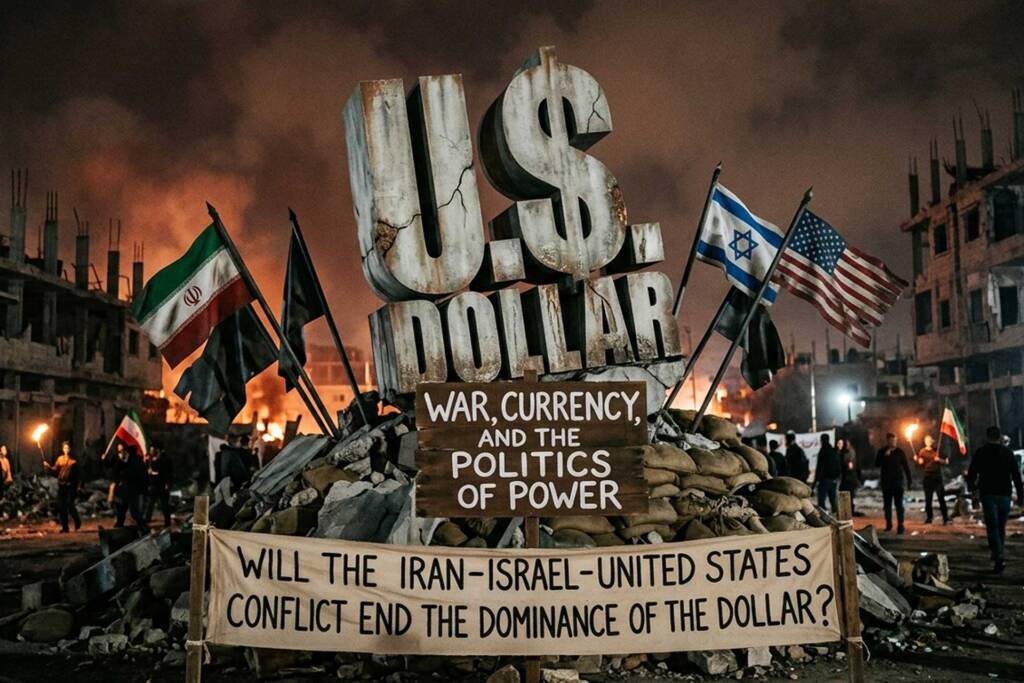
War, Currency, and the Politics of Power
Will the Iran–Israel–United States Conflict End the Dominance of the Dollar?
Dr. S. K. Das & A. Borhan
Introduction
The contemporary global financial system has rested for nearly eight decades on a central pillar: the dominance of the United States dollar. Following the end of the Second World War and the establishment of the Bretton Woods system, the dollar gradually emerged as the core currency of the world economy. As the principal medium of international trade, the primary reserve asset of central banks, and the central unit of global financial markets, the dollar has long maintained a position that is almost without rival.
However, the international environment today is undergoing rapid transformation. Geopolitical rivalries are intensifying, new economic alliances are emerging, and technological innovations are reshaping the architecture of global finance. Within this changing context, escalating tensions involving Iran, Israel, and the United States have raised an important question: could this Middle Eastern conflict weaken the global dominance of the dollar?
Some analysts argue that the war may undermine the petrodollar system and push countries toward alternative monetary arrangements. Others maintain that historical experience suggests the opposite — that geopolitical instability tends to strengthen rather than weaken the dollar.
A careful examination of recent trends in global economics and international politics reveals a subtle but significant reality: in the short term, the Iran–Israel–United States conflict is unlikely to break the dominance of the dollar; however, in the long term it may accelerate the gradual emergence of a more multipolar international monetary system. To understand why this is so, it is necessary to first examine the structural foundations of dollar dominance, then the institutional mechanisms that actively reproduce it, and finally the emerging trends that are beginning to erode it.
The Structural Foundations of Dollar Dominance
To understand the resilience of the dollar, one must first examine the structural foundations that support it within the global economy. The scale of dollar usage across international finance is extraordinary:
- Approximately 56–58 percent of the world’s foreign-exchange reserves held by central banks are still denominated in US dollars, compared to roughly 20 percent for the euro and less than 3 percent for China’s renminbi (IMF COFER, 2025).
- Nearly 80 percent of international trade finance is conducted in dollars.
- Around half of global trade transactions are invoiced in dollars.
- Approximately 90 percent of foreign exchange transactions involve the dollar on one side of the exchange.
- The US Treasury bond market, valued at approximately $27 trillion, constitutes the largest and most secure sovereign debt market globally.
Several structural factors explain this dominance. First, the financial markets of the United States remain the deepest and most liquid in the world. Second, the legal and institutional framework of the United States continues to inspire confidence among international investors. Third, a powerful network effect operates within the global currency system: once a currency becomes widely used in international transactions, shifting away from it becomes extremely costly. Fourth, the military and geopolitical power of the United States indirectly reinforces the global financial system centred on the dollar. For these reasons, replacing the dollar rapidly would be exceptionally difficult.
Yet it is precisely these structural strengths that have also become instruments of political power — and it is the political exercise of that power that is now generating the most significant pressures for change.
The Institutional Architecture: Reproduction of Hegemony
The dollar’s dominance does not rest on market forces alone; it is actively reproduced through international institutions—specifically the IMF, the World Bank, and the Paris Club. These organizations function as “dollar-transmission mechanisms,” embedding U.S. currency into the sovereign survival of developing nations.
- The IMF and World Bank as Transmission Mechanisms
The IMF and World Bank extend loans and financial assistance almost exclusively in U.S. dollars. This creates a “dollar-denominated debt trap” for the Global South. Developing countries are compelled to maintain massive dollar reserves to service these debts. When the Federal Reserve raises interest rates (as seen post-2022), capital flees the Global South for the safety of U.S. Treasuries. This leads to local currency depreciation, which increases the real-world cost of dollar-denominated debt, often forcing these countries into further IMF conditionality.
IMF programs frequently mandate export-oriented policies, requiring nations to earn dollars to pay back dollar debt. This prevents domestic-focused investment and ensures these economies remain permanently integrated into the dollar-centric system. The accumulation of dollars in the Global South often occurs at the direct expense of necessary domestic infrastructure and social spending.
- The Paris Club and Structural Colonialism
The Paris Club, an informal group of 22 Western creditor nations, operates as a tool of financial diplomacy. By negotiating as a united front while forcing debtor nations to negotiate in isolation, it maintains a lopsided power dynamic. The case of Sri Lanka in 2022 demonstrated this: the Paris Club echoed IMF requirements that all creditors, including China and India, provide consent before relief could be granted. This effectively blocked alternative bilateral financial arrangements and reinforced Western creditor control.
Statistically, 62% of developing country external debt is denominated in dollars. Consequently, any appreciation of the U.S. dollar acts as a form of “structural colonialism,” increasing the debt burden of the poor without a single new cent being borrowed (Vasudevan, 2009)
The Petrodollar’s Legal and Political Architecture
The petrodollar system was a deliberate political construction, initiated by the 1974 U.S.-Saudi agreement. In exchange for military protection, Saudi Arabia committed to pricing oil in dollars and recycling profits into U.S. Treasuries. These petrodollars were then loaned to Global South nations—particularly in Latin America—to cover rising energy costs, locking them into a dollar-denominated debt cycle.
This established a circular, self-sustaining architecture: oil demand necessitates dollar reserves, which fund cheap U.S. debt and military hegemony, which subsequently enforces the oil-for-dollar mandate. SWIFT serves as the technological enforcement layer; because dollar transactions transit the U.S. banking system, Washington can weaponize this infrastructure to impose sanctions and sever adversaries like Iran and Russia from global finance.
War and the Safe-Haven Currency Effect
An intriguing and often overlooked reality of global finance is that geopolitical conflict often strengthens rather than weakens the dollar. When international conditions become unstable, investors tend to move toward assets that are safe, stable, and highly liquid. US Treasury bonds have long been regarded as the world’s most reliable safe-haven assets.
Recent financial market behaviour during the Iran–Israel tensions has reflected this same pattern. As uncertainty increased in global markets, investors gravitated toward dollar-denominated assets. Similar dynamics were observed during the global financial crisis of 2008 and the COVID-19 pandemic. In other words, global instability often paradoxically reinforces the strength of the dollar. This tendency has almost become a self-fulfilling prophecy — one that neoliberal financial ideology frequently employs to further consolidate the dominance of the dollar-based financial order.
This safe-haven dynamic is critical because it means that the very conflicts and crises that motivate countries to seek alternatives to the dollar simultaneously make it harder to do so in the short term, as the dollar appreciates precisely when it is most needed. The contradiction between the long-term incentive to de-dollarise and the short-term compulsion to hold dollars is one of the most powerful mechanisms sustaining dollar hegemony.
The Weaponisation of the Financial System
Yet the very strength of the dollar has also produced a new and deepening challenge. Over the past two decades, the United States has increasingly used financial sanctions as a tool of international politics. Through sanctions imposed on countries such as Iran, Russia, and Venezuela, the dollar-centred financial system has effectively been transformed into a geopolitical weapon. Such measures provide Washington with immense strategic leverage. At the same time, however, they create powerful and historically unprecedented incentives for other nations to reduce their dependence on the dollar.
Three developments illustrate this dynamic concretely:
- Russia has significantly reduced its holdings of US Treasury bonds and has redirected bilateral trade increasingly into non-dollar currencies.
- China has developed its own international payment system, known as CIPS (Cross-Border Interbank Payment System), as a direct institutional alternative to SWIFT.
- Many countries have begun conducting bilateral trade using their local currencies, a trend that has accelerated sharply since the freezing of approximately $300 billion of Russian foreign reserves following the Ukraine war in 2022.
The freezing of Russia’s reserves was particularly significant because it demonstrated to every sovereign wealth manager in the world that dollar-denominated reserves held in Western financial institutions could be seized at the political discretion of the United States. This created a qualitatively new risk calculus for central banks globally and is a primary driver of the acceleration in reserve diversification documented in subsequent years.
The Measurable Decline: Concrete Evidence
The structural and political pressures described above are now producing measurable outcomes in the composition of global reserves. The data tell a consistent story of gradual but accelerating erosion.
The share of the US dollar in global foreign exchange reserves stood at 71.19 percent at the beginning of 1999 and fell to 56.92 percent by late 2025 — a decline of over 14 percentage points in a quarter century (IMF, 2025). The dollar’s reserve share has now reached its lowest level since 1994 (OMFIF, 2025).
This fragmentation of reserve diversification is itself significant: it signals that no single challenger is emerging, but rather a diffusion of alternatives. China has been the most deliberate actor, slashing its U.S. Treasury holdings by over 45% since 2013 (to $730.7 billion) while accumulating 74.06 million troy ounces of gold to prepare for a post-dollar era. Adding to this structural pressure, the dollar index fell 11% in 2025—the sharpest decline since 1973—signaling that the currency may be undergoing a fundamental structural adjustment. This gold-buying strategy serves three explicit purposes: dollar diversification, safe-haven accumulation, and reserve currency preparation for a post-dollar or multi-currency era.
In 2025, the US dollar also experienced a sharp cyclical shock: the dollar index fell approximately 11 percent from January, its biggest loss since 1973 (Morgan Stanley, 2025). By January 2026, a further 1.2 percent decline followed (Atlantic Council, 2026). While some analysts attribute this to a cyclical correction following a 40 percent dollar appreciation between 2010 and 2024, others see it as an early signal of structural adjustment in the global economy (Atlantic Council, 2026).
The Challenge from the BRICS Bloc
The rise of emerging economies is further accelerating the push toward transformation of the global monetary system. The BRICS bloc — Brazil, Russia, India, China, and South Africa — along with its recently expanded membership including Saudi Arabia, Egypt, the UAE, Ethiopia, Iran and Indonesia, now represents approximately one-third of global economic output measured in purchasing power parity.
Within this grouping, discussions have increasingly focused on the use of local currencies in bilateral trade, the development of alternative international payment systems, and the possibility of a BRICS settlement currency. Although these initiatives remain at an early stage, they form part of a broader strategic effort to reduce reliance on Western financial infrastructure. Iran’s announcement regarding the use of the yuan in oil transactions through the Strait of Hormuz represents one concrete instance of this broader shift, potentially introducing a new element into global energy trade that further weakens the petrodollar architecture.
It is important, however, to maintain analytical realism about BRICS. The bloc is a heterogeneous grouping with significant internal rivalries, particularly between India and China. A shared BRICS currency faces enormous political and institutional obstacles, and most serious analysts do not expect it to materialize within any foreseeable timeframe. The more significant development is the use of bilateral local-currency arrangements, which individually are modest but cumulatively represent a meaningful erosion of the dollar’s transactional monopoly.
Energy Markets, the EV Revolution, and the Future of the Petrodollar
The west Asian conflict raises yet another structural question: the future of the petrodollar system. Since the 1970s, the vast majority of global oil trade has been priced in US dollars. Because oil remains the most important traded commodity in the world, the petrodollar system has long sustained global demand for the dollar. However, recent developments suggest that this structure is beginning to evolve under pressure from multiple directions simultaneously.
China has been encouraging oil exporters to trade crude through the Shanghai Energy Exchange using yuan-denominated contracts. Russia and Iran — both subject to Western sanctions — have already begun conducting substantial portions of their energy trade outside the dollar system. Due to Western sanctions, Russian oil products exported eastward and southward are being sold in the local currencies of buyers, or in the currencies of countries Russia perceives as friendly, including India, China and Turkey (J.P. Morgan Research, 2023).
Beyond these geopolitical shifts, a longer-term structural threat to the petrodollar is emerging from the electric vehicle revolution. Global oil demand is projected to stagnate after 2026 and potentially decline by 2030 as EV adoption accelerates. As transportation electrifies, the structural demand for oil diminishes, reducing the necessity for nations to hold large dollar reserves to purchase energy — directly undermining one of the key mechanisms that has sustained dollar demand for five decades. China sold 11 million EVs in 2024 alone and now produces over 70 percent of global EV manufacturing capacity (EBC Financial Group, 2025). The country leading the energy transition is also the country most strategically motivated to price that transition outside the dollar system — a convergence with profound long-term implications for the petrodollar architecture.
If geopolitical fragmentation deepens alongside the energy transition, global energy markets could gradually become priced across multiple currencies. Nevertheless, such transformations are likely to occur over decades rather than years, and the dollar’s role in commodity pricing will not be displaced quickly.
The Limitations of Dollar Alternatives
Any serious analysis of de-dollarisation must be balanced by a rigorous assessment of the constraints facing potential alternatives. The structural weaknesses of rival currencies are as important as the structural weaknesses of the dollar itself.
Although the euro plays a major international role, the European Union still struggles with structural political and fiscal fragmentation. The absence of a unified European sovereign debt market comparable in scale to the US Treasury market is a fundamental constraint on the euro’s reserve currency ambitions. The Chinese yuan, despite expanding internationally, remains limited by China’s strict capital controls and relatively restricted financial transparency — factors that make many international investors, including central banks of states that are otherwise sympathetic to China, deeply cautious.
The Federal Reserve’s own 2025 analysis notes an unexpected digital reinforcement of dollar dominance: approximately 99 percent of stablecoin market capitalisation is linked to the dollar, implying that crypto assets — often discussed as a route to de-dollarisation — are de facto traded in dollars (Federal Reserve Board, 2025). This suggests that technological innovation, at least in its current form, is reinforcing rather than undermining dollar dominance.
Most importantly, no other currency currently has a financial market comparable in size and liquidity to the US Treasury market. Given these realities, the most plausible future scenario is not the replacement of the dollar by a single rival currency, but rather the gradual emergence of a multipolar international monetary system in which several major currencies share functional roles across different regions and transaction types.
The Emergence of a Multipolar Currency Order
Several trends suggest that the global financial system may gradually diversify over the coming decades. Many central banks around the world are increasing their gold reserves. At the same time, regional currencies such as the euro and the yuan are expanding their roles within specific economic zones. Technological innovations may also play an important role. Central bank digital currencies and new cross-border payment systems could reshape the mechanisms of international financial transactions. In such a scenario, the dollar may remain the most important global currency, but its share in global reserves and trade may gradually decline.
Conclusion
The Iran–Israel–United States conflict reflects a broader transformation in the global balance of power. In isolation, no single war is capable of dismantling a financial architecture built over eight decades and embedded in the institutional fabric of global trade, debt, and diplomacy. The assumption that it could represents an overestimation of the disruptive power of military conflict and an underestimation of the structural inertia of financial systems.
Yet the emerging trends themselves cannot be dismissed. The measurable decline in the dollar’s reserve share, China’s systematic de-dollarisation programme, the acceleration of bilateral local-currency trade arrangements, the threat posed by the EV revolution to the petrodollar, and the growing political contestation of Western-controlled financial institutions together constitute a structural shift of historic significance — even if its full consequences will unfold over decades rather than years.
The dollar’s decline is fundamentally a political issue, not a financial one. Established in 1944, the IMF, World Bank, and Paris Club institutionalized U.S. hegemony through dollar-denominated debt and policy conditionality. By weaponizing this architecture—via SWIFT exclusions and asset freezes—the U.S. has triggered an active de-dollarization push that natural market evolution alone could not have achieved.
In the short term, global instability will likely continue to strengthen the dollar through the safe-haven effect. In the long run, however, the increasing use of financial sanctions, the redistribution of economic power toward the Global South, the energy transition, and the development of new financial technologies will gradually diversify the global monetary system. For many countries in the Global South, the present moment calls for serious reflection on alternative economic arrangements — otherwise, successive crises will continue to be used to further consolidate the grip of an international monetary order that extracts resources from the periphery to sustain the centre.
The real question, therefore, may not be when the dollar will fall, but rather how the balance of global economic power will be reconfigured in the twenty-first century — and whether the institutions of the Global South will be ready to shape that reconfiguration on their own terms.