After the Fireball: Life Rewrites the Earth
Sixty-six million years ago, Earth experienced a moment so abrupt and violent that it cleaved geological time in two. A rocky body roughly ten to twelve kilometers in diameter struck what is now the Yucatán Peninsula, releasing an energy equivalent to billions of nuclear bombs. This was the Chicxulub impact, the physical signature of the boundary between the Cretaceous and Paleogene periods. What followed was not merely destruction, but a planetary experiment in extinction, survival, and renewal.
The Silence After Impact
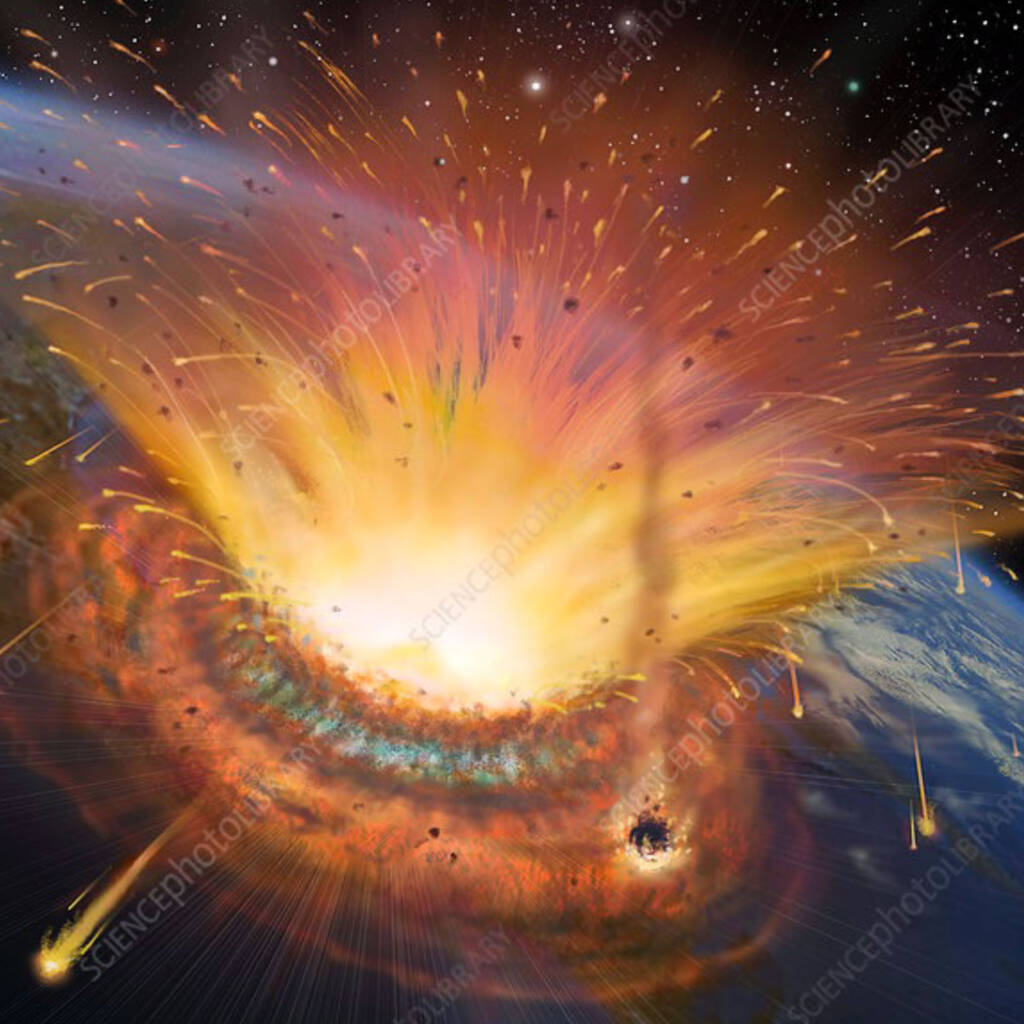
In the first hours, the impact excavated a crater nearly 180 kilometers wide. Rock vaporized; oceans surged into mega-tsunamis. Ejecta—molten droplets and pulverized stone—were hurled into the upper atmosphere and fell back as a global rain of fire. Forests burned on multiple continents. Shockwaves reverberated through the crust.
But the most consequential effect unfolded over months and years rather than minutes. Fine dust, sulfate aerosols, and soot injected into the stratosphere blocked sunlight. Photosynthesis collapsed. Global temperatures dropped sharply in what scientists describe as an “impact winter.” Food webs unraveled from their base upward. Large-bodied animals with high metabolic demands and specialized diets were hit hardest. Non-avian dinosaurs—dominant on land for over 160 million years—disappeared entirely, along with ammonites, many marine reptiles, and a vast fraction of plankton species.
Earth entered a rare state: biologically impoverished, ecologically simplified, and eerily quiet.
Survivors in the Ash
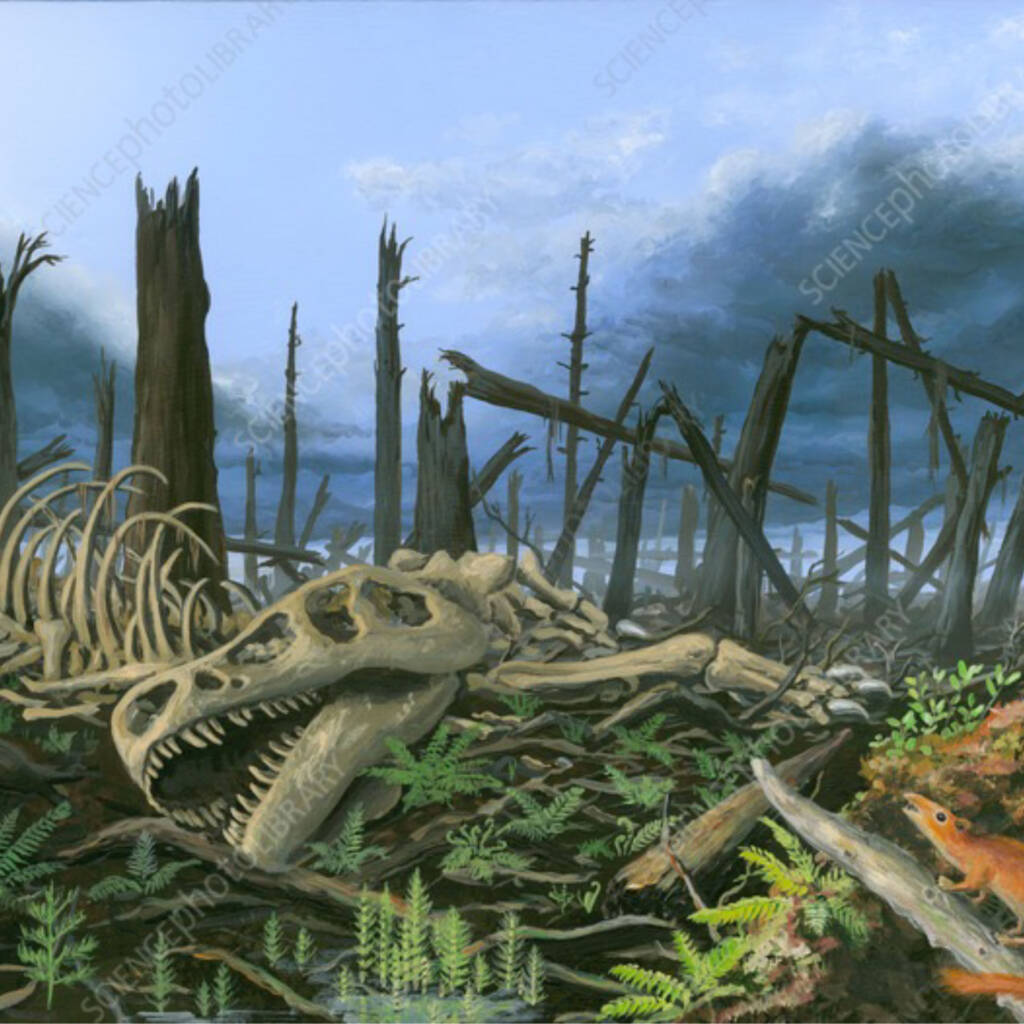
Yet extinction was not total. Life persisted in refuges shaped by chance, physiology, and ecology. Seeds buried in soil, spores sealed within protective coats, and hardy ferns endured where forests had burned. In oceans, organisms that could feed on detritus or endure low productivity survived the collapse of plankton.
Among animals, survival favored small size, flexible diets, and sheltering behaviors. Birds—the avian descendants of certain theropod dinosaurs—persisted, as did crocodilians, turtles, amphibians, and many insects. Mammals, then mostly small, nocturnal creatures rarely larger than a modern rat, slipped through the catastrophe. Their insulation, varied diets, and ability to shelter underground or in crevices gave them a narrow but decisive edge.
This was not triumph; it was endurance.
The Green Return
As the dust slowly settled and sunlight returned, the planet entered a phase of ecological resurrection. One of the earliest botanical signals of recovery is known as the fern spike: fossil records show an abrupt global dominance of ferns immediately after the impact. Ferns reproduce by spores and colonize disturbed landscapes rapidly, much like they do after modern volcanic eruptions or wildfires. They were the first green veil drawn over a scarred Earth.
Gradually, seed plants returned. Flowering plants (angiosperms), already diverse before the impact, expanded into newly available niches. With them came insects—pollinators, herbivores, decomposers—reweaving the fabric of terrestrial ecosystems. Soil stabilized, nutrient cycles resumed, and food webs gained complexity.
Life did not return to what it had been. It reorganized.
An Empty World and an Open Future
The extinction of non-avian dinosaurs did not cause mammals to evolve; mammals had existed alongside dinosaurs for over 100 million years. What the extinction did was remove ecological ceilings. Large herbivores and apex predators were suddenly absent. Forest canopies, plains, riverbanks, and shorelines were available to new occupants.
In the Paleocene epoch that followed, mammals underwent an adaptive radiation. Within a few million years—geologically rapid—they diversified in body size, diet, and locomotion. Some became specialized herbivores with grinding teeth; others evolved carnivorous dentitions. Limbs adapted for running, climbing, digging, and swimming. Brains increased in relative size, particularly in lineages that exploited complex environments.
This diversification was not directed or inevitable. It was contingent—shaped by the particular survivors, the altered climate, and the ecological vacancies left behind. Evolution here was not a ladder but a branching tree, growing into light where shade had once prevailed.
A Changed Planet
The post-impact Earth was warmer in the long term, with greenhouse gases released by fires and disrupted carbon cycles. Continental positions, sea levels, and atmospheric composition continued to shift. Mammals adapted within this dynamic context, as did birds, insects, and plants. Coral reefs reassembled, plankton diversified anew, and oceans regained productivity.
What emerged over tens of millions of years was a biosphere fundamentally different from the one the asteroid had erased—one in which mammals, eventually including primates, would play a central role.
No Resurrection—Only Continuity
There was no literal resurrection of the dead. Dinosaurs did not return. Entire evolutionary histories ended permanently. What followed was continuity through change: life persisting by transforming, ecosystems rebuilt from remnants, and evolution proceeding without foresight or intention.
The asteroid’s collision reminds us that dominance in nature is temporary, survival is conditional, and the future belongs not to the strongest, but to the sufficiently adaptable. From ash-covered ground and dimmed skies arose forests, animals, and ultimately observers capable of reconstructing this deep past from stone and bone.
The mammals did not inherit the Earth as heirs. They occupied it as survivors in a world reset—not empty, but open.
-S. K. Das Department of Physics Shahjalal University of Science and Technology (SUST), Sylhet, Bangladesh